
By Peter Corcoran
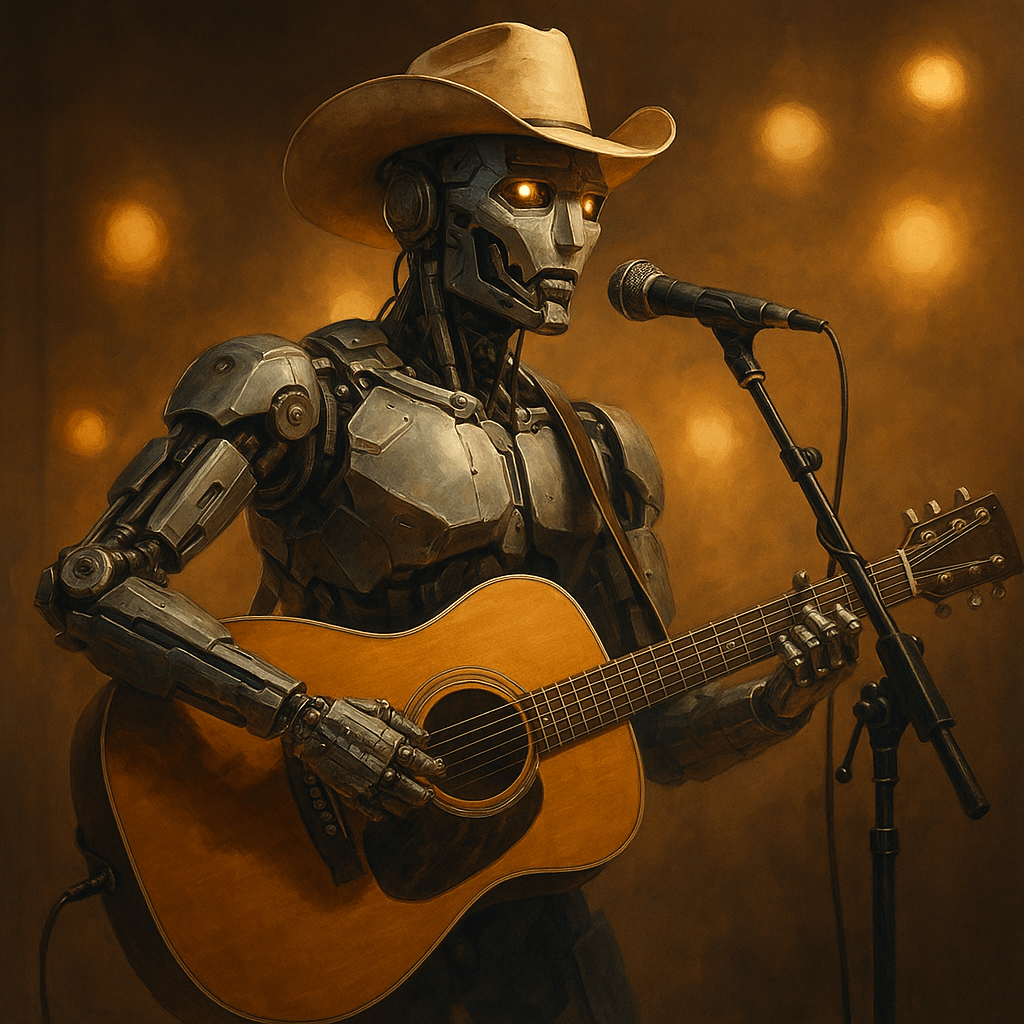
When an AI-generated country song—Walk My Walk—hit #1 this week, the music world did what it always does when something unfamiliar shows up: it argued, panicked, theorized, and spiraled. Was it the end of the industry? The death of real artists? A threat to authenticity?
But I’ve been living on the other side of that conversation.
Not as an AI maximalist, not as a futurist shouting about the takeover—
but as a creator who’s finally been able to make the kind of music I always heard in my head but could never get out fast enough with traditional tools.
Over the last year, I’ve written and released more songs than at any other time in my life. Country, worship, acoustic, rock, narrative concept albums, multiverse editions—entire stories told through melody. AI didn’t replace my creativity; it unlocked it. It lowered the barrier between inspiration and production so drastically that it felt like someone removed the weight vest I’d been wearing for decades.
And that’s the part of this conversation that rarely gets said out loud:
AI doesn’t only create songs.
It creates access.
Music Has Always Been Gatekept by Ability
For most of history, being a “musician” required a narrow set of abilities:
- sing on key
- play an instrument
- record in a studio
- afford production
- navigate the industry
- have the time, health, and stamina to perform
If you lacked those abilities—even if you had incredible ideas—you were, in effect, creatively disabled. Not in the medical sense, but in the structural sense. You were shut out of the space where your voice might have mattered.
The music industry has been dominated by people with the right kind of abilities, not the right kind of stories.
AI shifts that.
Not by replacing talent, but by allowing more forms of talent to count.
AI Doesn’t Flatten Creativity — It Multiplies It
When I create today, I’m not trying to sound like a machine.
I’m using a tool that removes the friction between imagination and output.
I still write lyrics.
I still design the stories behind the albums.
I still craft the emotional arc, the theology, the imagery, the resonance.
But now:
- A genre doesn’t limit me.
- A lack of vocal range doesn’t silence me.
- A busy schedule doesn’t stop me.
- Production barriers don’t slow me down.
I can move from an idea to a finished song in hours instead of months. I can create a whole albums of music—12-18 tracks telling a unified story—without the roadblocks that once made an idea die before it had the chance to breathe.
That’s not cheating.
That’s liberation.
More Voices Doesn’t Devalue the Stage
People fear AI because they believe:
“If everyone can make music, the value of music goes down.”
Every time creation becomes easier:
But history says the opposite, and I say:
“When everyone can make music, more people can share how they feel — and they no longer have to bear it alone.”
And we’ll see
- literacy explode
- art flourishe
- publishing grow
- storytelling diversify
People who were shut out—people with physical limitations, financial limitations, time limitations, health limitations—can finally express something that has been trapped inside them for years.
Imagine the autistic creator who struggles with performance anxiety.
The veteran with tremors who can no longer play guitar.
The parent working two jobs with no time to spend in a studio.
The writer with deep stories but no singing voice.
The person with a speech impediment who has always wanted to share a song.
The kid in a rural town with no access to equipment.
The person whose trauma gave them art, but not the ability to perform it.
AI doesn’t diminish their humanity.
It amplifies it.
Isn’t that what accessibility is about?
We Celebrate Accessibility Everywhere Else—Why Not in Creativity?
Our society builds ramps, captions, sensory rooms, ergonomic tools, accessible workplaces, and adaptive technologies—not because they diminish the “real” experience, but because they allow more people to participate in it.
AI is the ramp into the music industry.
Not everyone needs it.
Not everyone will use it.
But for those who do, it’s not replacing ability — it’s restoring opportunity.
It’s letting unheard voices sing.
It’s giving storytellers a microphone.
It’s expanding the definition of what a “musician” can be.
And that’s not a threat.
That’s the most human thing technology has done in decades.
**So when an AI song hits #1, the question isn’t “What are we losing?”
It’s “What voices are we finally about to hear?”**
Because if creativity is a human birthright, then tools that help humans create more freely aren’t the enemy.
They’re the breakthrough.
Isn’t that a good thing?
Check out “Stories We’re Not In“, “ZeroTrust“, and “Gifted For His Glory” my AI generated content:
https://www.youtube.com/@storieswerenotin
https://www.youtube.com/@ZeroTrustBand

 VRAISON AI BLOG - By Pete Corcoran
Leave a comment