
For years, software development has followed the same operational pattern: gather requirements, divide work into specialized teams, move tickets between silos, spend weeks coordinating dependencies, and slowly assemble something that works. AI-first development changes that equation not because AI magically replaces engineers, but because it fundamentally changes how systems can be composed, orchestrated, and evolved.
Recently, I built a fully operational AI-assisted content orchestration platform in roughly a single working day. The most interesting part wasn’t the speed. It was what the architecture revealed about where software development is heading.
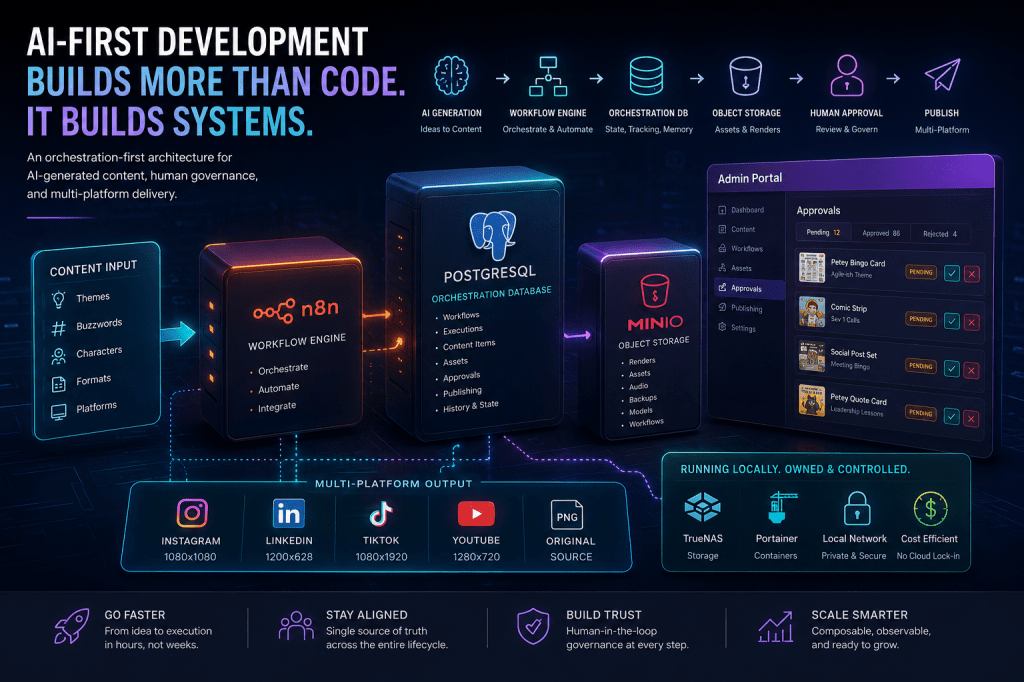
The platform combined workflow orchestration, AI-assisted generation, object storage, approval governance, execution tracking, multi-platform asset rendering, and human-in-the-loop review. What emerged wasn’t a collection of AI tools. It became a coordinated operational system.
From Applications to Orchestration
Traditional systems are application centric. Business logic lives inside services, databases primarily store data, and workflows are often implicit buried inside application code. AI-first systems behave differently.
The architecture I built centered around a workflow-oriented orchestration model where the database maintains operational state, workflows react to lifecycle transitions, AI participates as a synthesis subsystem, and humans govern approval and quality. Each discrete component works in harmony while remaining independently replaceable.
That distinction matters. The platform itself is not “the AI.” The platform is the orchestration layer coordinating execution, validation, storage, governance, rendering, and publication readiness. AI is simply one participant in that operational fabric.
The Database as Conductor
One of the most important architectural decisions was treating the database as more than storage. It became orchestration memory: maintaining workflow coordination state, execution tracking, asset lineage, approval history, and lifecycle synchronization. This created a persistent operational backbone that allowed multiple systems to coordinate naturally. The orchestration engine could react to workflow state. The admin portal could surface approvals and render status. The storage layer could organize generated assets by lifecycle stage.
The entire platform became state-aware rather than prompt-aware and that’s a critical distinction in AI-first architecture.
Most AI tooling today is effectively stateless: prompt in, output out. But production-grade AI systems require memory, governance, execution awareness, approval workflows, and operational traceability. Without orchestration state, AI systems remain disconnected utilities rather than coordinated platforms.
Human Governance Still Matters
One of the biggest misconceptions in AI development is that autonomy is the end goal. In reality, the most effective AI systems are often human-governed ones. The platform included approval queues, review workflows, multi-stage asset handling, validation checkpoints, and regeneration capability. The flow looks simple in practice generate, validate, review, approve, publish but that simplicity is the point. AI accelerates synthesis. Humans still provide judgment. That balance is where operational trust actually emerges.
Infrastructure Strategy Follows Architecture
Another important realization was cost structure. The entire platform was designed around local-first infrastructure wherever practical: local orchestration, local object storage, local administration, self-hosted workflow management, and hybrid AI integration. Running locally dramatically reduced operational cost while improving control, portability, and iteration speed. Rather than depending entirely on cloud-native SaaS tooling, the architecture emphasized composable infrastructure layers that could operate independently.
That flexibility becomes increasingly important as AI workflows scale. AI-first systems don’t necessarily require massive cloud expenditure. In many cases, intelligent orchestration and thoughtful architecture matter more than raw infrastructure spend.
The Architect’s Role Is Changing
The modern architect is no longer just designing static systems. They’re orchestrating operational ecosystems. AI-first development shifts engineering effort away from repetitive implementation and manual coordination toward system composition, orchestration design, workflow topology, governance modeling, and lifecycle management. The bottleneck is no longer simply writing code it becomes designing systems that can coordinate intelligence effectively.
AI-first development is ultimately about collapsing the distance between architecture and execution. The future engineer may spend less time manually building isolated components and more time designing systems that can generate, validate, coordinate, govern, and evolve alongside them.
The most valuable systems won’t be the ones with the most AI. They’ll be the ones where orchestration, state management, infrastructure, and human judgment work together as a cohesive operational platform.

 VRAISON AI BLOG - By Pete Corcoran
Leave a comment